ETH Cloud Miner- Earn Ethereum
- 4.3
- Rating
- 100.00K
- Installs
- Free
- Price
 Analysis by App-foxy
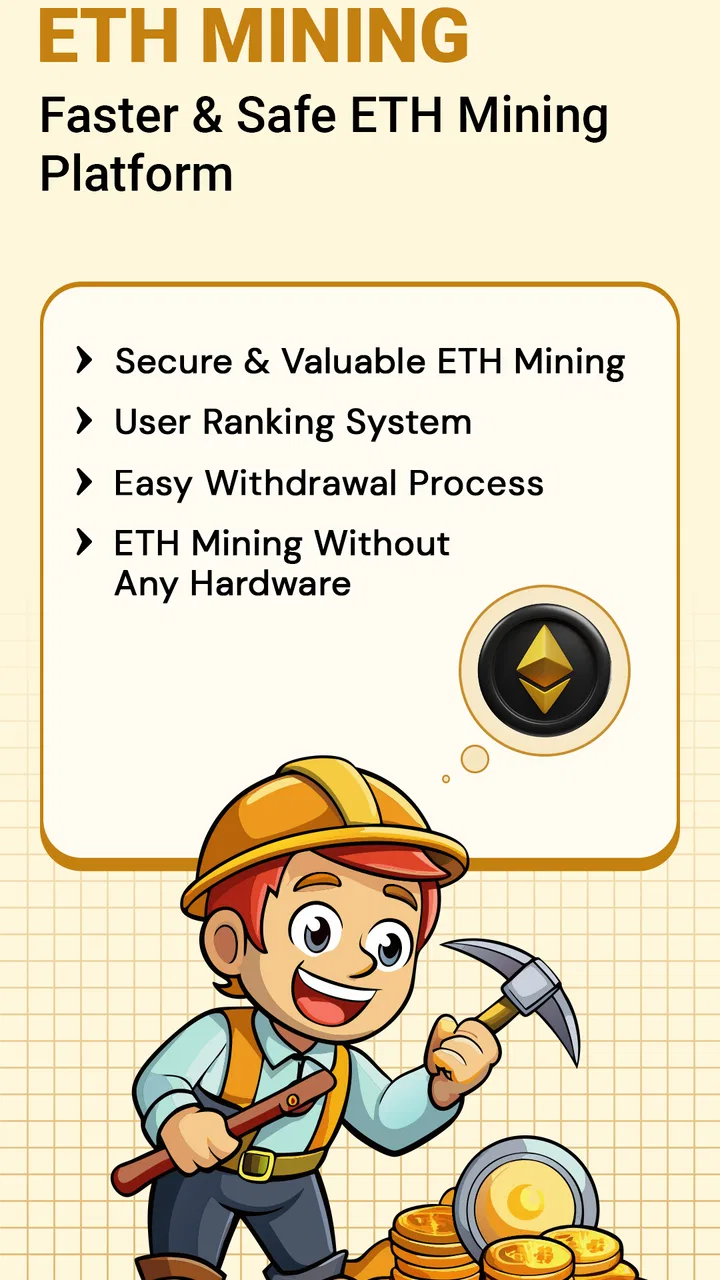
I approached ETH Cloud Miner- Earn Ethereum as an Events app rather than as a conventional cryptocurrency wallet or a desktop mining replacement. Its central idea is simple: you start a cloud-mining session inside the app and follow the progress toward earning ETH without running mining hardware on your own phone. That makes it immediately appealing to curious beginners, especially anyone who wants to understand the basic rhythm of cloud mining without buying equipment.
My first impression is that the app is easier to approach than a traditional mining setup. There is no need to configure a graphics card, choose a pool, manage cooling, or leave a computer working all day. At the same time, that simplicity means I had to judge it differently. The important question is not whether a phone can perform serious Ethereum mining, but whether the app gives users a clear, repeatable way to interact with its cloud-mining concept and manage expectations about what those earnings mean.
Rio Crypto Devlopers presents it as a free app for Everyone, with a 4.2 average from around 3.7 thousand ratings and more than 100 thousand installs. Those figures suggest that it has found an audience among people interested in accessible crypto tools. The app is free to start, although optional in-app purchases range from $15.99 to $74.99 per item, so I would treat any paid option as a decision requiring careful thought rather than as a necessary part of the basic experience.
You May Also Like

 Blood Strike: 2.5 Anniversary
Blood Strike’s Loadouts Turn Every Drop Into a Tactical Gamble
A close look at Blood Strike’s custom loadouts: how fast access to signature weapons reshapes its battle royale rhythm, rewards preparation, and narrows the gap between fights.

 Pandora - Music & Podcasts
Pandora’s Music Is Easy to Start, but Harder to Recover
Pandora’s strength is its low-effort path from a seed to a station. Its weak spot is how much confidence it asks you to place in connection, setup, and quiet recovery.

 8 Ball Pool
 Is Built on Rivalries, Rematches, and Routine
A close look at the rivalries, rematches, shared routines, and unanswered safety questions that turn a quick pool match into a persistent mobile community.

 Samsung Music
’s Quiet Strength Is Playing What You Already Own
Its reach comes less from spectacle than from dependable access to a personal library. That simplicity is both the app’s strongest retention engine and its ceiling.

 AccuWeather: Weather Radar
AccuWeather Review: A Quick, Clear Forecast for Everyday Decisions
For everyday plans, the best forecast is the one you can understand quickly. AccuWeather makes rain timing, radar, and local conditions easy to act on, with a few trade-offs.

 Hill Climb Racing
Why Hill Climb Racing Still Turns Crashes Into One More Run
A tiny car, a bumpy hill and one more upgrade: Hill Climb Racing keeps resurfacing because its simple chaos makes every near-miss feel personal.
More From Our News Desk



How the everyday cloud-mining routine works
The most sensible baseline workflow is deliberately modest. I would open the app, inspect the current mining screen, start the available cloud-mining activity, and then return later to check progress rather than stare at it continuously. This approach fits the nature of a cloud service: the phone acts as the control panel, not as the machine doing demanding calculations locally.
That distinction matters for battery life and expectations. A user who believes the handset itself is mining Ethereum may assume that leaving the screen open will make the process more productive. I would avoid that habit. The useful routine is to start the session, confirm that the app reflects the action, and close it when finished. Reopening the app later gives a more practical view of the account than keeping it visible for hours.
I also recommend taking a few minutes to understand every label on the main screen before spending anything. Look for the balance, session status, any progress indicator, and the path used for account actions. A cloud-mining interface can feel reassuring because it presents numbers in real time, but a changing number is not automatically the same as withdrawable money. Before treating an amount as income, I would check what action is required to use it and whether the app distinguishes between an internal balance and a completed transfer.
For a realistic everyday scenario, imagine someone who follows cryptocurrency news during a commute. They could open the app once in the morning, begin or review the mining activity, and check it again in the evening. That is a better fit than repeatedly refreshing the screen while expecting dramatic changes. The app is most useful in this scenario as a lightweight way to observe a cloud-mining process, not as a replacement for employment, savings, or a serious mining operation.
The free entry point is helpful because it lets a newcomer learn the interface before making a financial commitment. I would stay with the free workflow until I understood the timing, balance display, and any account requirements. If the basic routine does not feel clear or worthwhile, paying for a higher option is unlikely to solve the underlying problem. A purchase should only be considered after the user understands exactly what it changes and accepts that cryptocurrency outcomes can be uncertain.
Settings and account details worth checking first
Experienced use starts with observation rather than speed. I would check whether notifications are genuinely useful or merely encourage frequent opening of the app. If the system offers notification controls through the phone, keeping only important alerts can make the routine less distracting. There is little benefit in allowing a mining app to become a constant interruption when the activity itself is designed to run in the cloud.
I would also review the phone’s battery and background-activity settings. Because this is a cloud-mining app, heavy local processing should not be the reason to leave it active indefinitely. Restricting unnecessary background behavior may improve battery discipline, though a user should avoid settings that prevent the app from recording a legitimate session or displaying account updates correctly. The practical goal is balance: let the app work when needed, but do not grant it more attention or battery access than the workflow requires.
Another useful check is the app version. The current version is 27.0, and it supports devices running Android 7.0 or later. Keeping the installation current is sensible for an app that handles account information and financial-themed activity. I would update through the official app marketplace and then revisit the main screens after an update, because labels, navigation, or session presentation can change even when the basic idea remains the same.
The age rating is Everyone, which makes the interface approachable for a broad audience. That should not be confused with financial suitability for every person. A simple design can make crypto activity look less risky than it is. I would explain the app carefully to younger or inexperienced users, especially around purchases, account security, and the difference between an in-app balance and money that has reached an external wallet.
Security habits are more important here than cosmetic settings. I would use a unique password wherever the app requires one, avoid sharing account credentials, and never send recovery information to someone claiming to offer faster mining. I would also be cautious with messages or offers that pressure me to pay immediately. The app’s free availability makes it easy to try, but it does not make every promotion associated with cloud mining trustworthy.
One practical habit is to record the date and balance when beginning a test period, then check again after a reasonable interval. This is not about inventing a return estimate; it is about replacing vague impressions with personal observations. If the balance barely changes, that is useful information. If a purchase is being considered, the user can compare the actual experience with the cost instead of relying on a large number displayed on a promotional screen.
Repeatable patterns that make the app easier to manage
The fastest pattern is not rapid tapping. It is consistency. I would use the same short checklist each time: open the app, confirm the account, inspect the mining status, start the available action if needed, and leave. Repeating those steps reduces the chance of confusing an old balance with a new session or overlooking a prompt that changes how the activity works.
For people who use several crypto apps, separating roles is especially helpful. I would keep this app focused on its cloud-mining activity and use a dedicated wallet for assets that are actually transferred and held outside the app. Mixing a mining dashboard, an exchange, and a personal wallet in one mental category makes it harder to understand where funds are located. Even if the app feels like a wallet because it displays ETH, I would not assume that it provides all the controls or protections of a standalone wallet.
A second efficient pattern is to review the app at fixed times instead of responding to every notification. A morning and evening check is enough for many casual users. This prevents the common mistake of treating a slowly changing cloud process like a game that rewards constant interaction. It also makes it easier to notice whether the app is adding genuine convenience or simply consuming attention.
I would avoid uninstalling the app during an active experiment unless I had first understood how the account and balance are preserved. Reinstalling an app can be harmless, but financial-themed services deserve a more cautious approach. Before changing phones or clearing app data, I would make sure I know the relevant login details and any recovery method available inside the account area. That is a small habit, but it prevents avoidable panic later.
Another non-obvious trade-off concerns paid upgrades. The visible price range, from $15.99 to $74.99 per item, is high enough that an impulse purchase deserves scrutiny. I would compare the purchase with the free experience, read the exact wording on the payment screen, and ask whether the benefit is understandable in practical terms. A faster-looking progress display is not enough. If the outcome depends on market value, withdrawal conditions, or continued participation, the purchase should be considered speculative rather than a guaranteed return.
Users should also decide in advance what would make them stop. For me, unclear balance rules, unexpected payment pressure, or a workflow that cannot be explained in plain language would be warning signs. Setting that boundary before becoming emotionally attached to a growing number is a useful protection. Cloud mining can feel passive, but the financial decisions around it are still active decisions made by the user.
Where the simple approach reaches its limits
The biggest limitation is conceptual. A cloud-mining app is not equivalent to owning mining hardware, joining a known pool from a computer, or buying ETH through an exchange. Those alternatives serve different purposes. Hardware mining offers direct control but demands equipment, electricity, maintenance, and technical knowledge. An exchange is usually more direct for someone whose goal is simply to acquire cryptocurrency. This app sits between those ideas: it offers an accessible mining-themed experience without giving the user the same physical control as operating a rig.
That makes it a poor choice for a user who wants transparent control over hash power, electricity costs, pool selection, or hardware performance. A technically experienced miner will probably prefer software and services that expose those details clearly. Someone who only wants price exposure to ETH may find a reputable exchange more straightforward, because buying an asset does not require interpreting a cloud-mining session or waiting for an internal balance to develop.
It is also not the right tool for anyone expecting predictable income. Cryptocurrency value can move, and a displayed earning figure does not remove that uncertainty. Even if the app is easy to use, the result should be treated as experimental or educational money. I would never use rent, emergency savings, borrowed funds, or money needed for a bill to buy an optional mining item.
Withdrawal is another area where careful reading matters. Before relying on any balance, I would look inside the app for the exact withdrawal route, minimum requirements, processing language, and identity or wallet steps. These details determine whether the experience is useful in practice. A number that cannot be moved when needed is not equivalent to spendable ETH, so I would test the free workflow and understand the account process before attaching real financial importance to the balance.
Privacy and permissions deserve the same practical attention. I would inspect what the phone asks the app to access and decline anything that does not appear necessary for its stated function. If a permission request seems unrelated to viewing a cloud-mining dashboard, I would pause rather than approve it automatically. This is a general mobile-security habit, but it becomes more important when an app is connected in the user’s mind with crypto and payments.
The app’s Events category is an interesting fit because it frames the experience around an ongoing activity rather than a static information page. That can make returning to it feel natural, but it may also encourage users to check progress more often than needed. I would use the event-like structure as a reminder to follow a routine, not as a reason to chase every small update.
Who will enjoy it and who should skip it
I can recommend trying it to a beginner who wants a gentle introduction to the language of cloud mining and prefers a phone-based interface. It is also suitable for a curious user who understands that the free version is a learning exercise and wants to observe how an app presents mining progress. The low barrier to entry makes it easier to explore than assembling a computer-based mining setup.
I would be more cautious recommending it to a user whose main goal is investment. For that person, the better option may be a well-established exchange or wallet with clear ownership and transfer controls. Likewise, a serious miner should compare it with dedicated mining software or a transparent hosting service. The right choice depends on whether the user values simplicity, direct asset purchase, or technical control.
Parents and educators should also frame it carefully. The Everyone rating describes accessibility, not financial education. A young user may understand the buttons without understanding volatility, payment risk, or the difference between an app balance and a blockchain transaction. If a child uses it, I would keep purchases disabled unless an adult has reviewed them and discussed why free trials and paid upgrades are not the same thing.
For me, the app’s strongest use case is a controlled trial. I would install it, learn the workflow, use it without buying anything, and keep notes about clarity and convenience. If the process feels transparent and useful for my specific purpose, I could decide whether it deserves a place among my crypto tools. If I find myself checking it compulsively or feeling pushed toward a purchase, I would stop using it.
My final assessment after using the full routine
ETH Cloud Miner- Earn Ethereum is approachable because it turns cloud mining into a phone-centered routine instead of a hardware project. I like that a newcomer can begin without building a rig, and the free starting point makes exploration less intimidating. The app is easiest to appreciate when treated as a simple dashboard for an ongoing cloud-mining activity rather than as a promise of dependable earnings.
Its weaknesses come from the same simplicity that makes it accessible. A polished progress screen can hide the questions that matter most: what the balance represents, how it can be used, what a paid option changes, and how much control the user really has. Those questions should be answered before spending money, not after. I would also keep a separate wallet or exchange in mind when the real goal is holding or purchasing ETH directly.
Rio Crypto Devlopers has built an app that is easy to test, and its broad audience shows that the concept is understandable to many people. The version available now is 27.0, and the Android requirement of 7.0 or later keeps it accessible to older compatible devices. Still, accessibility should be paired with restraint. My advice is to begin with a short, free observation period, use a fixed checking routine, review account and withdrawal details carefully, and treat every optional purchase as speculative.
In the end, I would recommend it to curious beginners who want to explore cloud mining from a mobile device, provided they keep their expectations realistic. I would not recommend it as a substitute for a transparent exchange, a personal wallet, or a professionally managed mining setup. Used patiently, it can be an approachable introduction to the subject. Used as a shortcut to guaranteed crypto income, it is the wrong tool.
FAQs for ETH Cloud Miner- Earn Ethereum
01What is ETH Cloud Miner and how does it work?
ETH Cloud Miner is a mobile application designed to help users mine Ethereum without the need for physical mining equipment. It utilizes cloud computing to perform mining operations. By leveraging remote data centers, the app allows users to earn Ethereum passively. Users can track their mining progress and earnings within the app interface.
02Is ETH Cloud Miner safe to use on my device?
Yes, ETH Cloud Miner is generally regarded as safe for both Android and iOS devices. However, it’s crucial to download the app from reputable sources such as the Google Play Store or Apple App Store to avoid any potential security risks. Always ensure your device is up-to-date with the latest security patches.
03How much Ethereum can I earn using ETH Cloud Miner?
The amount of Ethereum you can earn with ETH Cloud Miner depends on several factors, including the time you spend mining and the app's efficiency. Cloud mining typically offers lower earnings compared to traditional methods due to shared resources and fees involved. It's important to manage your expectations regarding potential earnings.
04Does ETH Cloud Miner require any upfront investment or subscription fees?
ETH Cloud Miner may offer free versions, but certain features might require in-app purchases or subscriptions to enhance mining capabilities. Users should carefully review any associated costs and ensure they understand the terms before committing to any financial investment within the app.
05Can I withdraw my earnings directly from ETH Cloud Miner?
Yes, ETH Cloud Miner allows users to withdraw their earnings, typically after reaching a minimum balance threshold. The app will guide you through the withdrawal process, often requiring a compatible Ethereum wallet address. Ensure your information is accurate to avoid any delays or issues with withdrawal.
Pros
- Easy-to-use interface for beginners.
- No prior crypto knowledge needed.
- Low battery consumption during use.
- Regular updates with new features.
- Supports multiple withdrawal options.
Cons
- Limited to Ethereum mining only.
- Requires constant internet connection.
- Ads can be intrusive at times.
- Earning potential varies greatly.
- May not work on older devices.

ETH Cloud Miner- Earn Ethereum
Gallery